After more than a decade in Baden-Baden, the Berliner Philharmoniker returns to the Salzburg Easter Festival, re-establishing its residency at the event it originally founded with Herbert von Karajan in 1967. The 2026 edition, which opens on 27 March, marks both a historical return and the beginning of a new long-term artistic project centred on Der Ring des Nibelungen under chief conductor Kirill Petrenko.
For more than four decades, the Berliner Philharmoniker was at the core of the festival’s identity, accompanying staged opera productions in Salzburg each Easter. That relationship came to an end in 2013, when the orchestra moved its Easter activities to Baden-Baden. Its return in 2026 restores a defining partnership in the festival’s history, while also opening a new chapter shaped by the current artistic leadership of Petrenko and Intendant Nikolaus Bachler.
According to the orchestra, the new residency represents both a return and a new beginning, linking the festival’s origins with a renewed artistic direction.
A return to origins
The Salzburg Easter Festival was founded by Karajan as a platform to realise his vision of opera with the Berliner Philharmoniker in the pit, at a time when Wagner’s works were not staged in Salzburg during the summer festival. From its first edition, built around Der Ring des Nibelungen, the Easter Festival established itself as a distinct space where symphonic excellence and operatic production could be combined.
Karajan’s successors, Claudio Abbado and Simon Rattle, continued to develop this model, introducing new repertoire and expanding the festival’s artistic profile while maintaining its central focus on staged opera.
After the orchestra’s departure, the festival entered a period of transformation, first under Christian Thielemann with the Staatskapelle Dresden and later under Bachler, who introduced a rotating system of visiting orchestras between 2023 and 2025. The return of the Berliner Philharmoniker in 2026 marks the end of that transitional phase and the restoration of a permanent artistic partnership.
This year’s edition: Das Rheingold
At the centre of the 2026 edition is a new staging of Das Rheingold, conceived as the opening instalment of a new Ring cycle to unfold over several seasons. The production, directed by Kirill Serebrennikov, opens on 27 March at the Felsenreitschule, a venue closely associated with the festival’s operatic productions.
Wagner described Das Rheingold as the “preliminary evening” of the cycle, establishing its musical language and dramatic structure. Its selection as the starting point reflects both the narrative logic of the work and the long-term ambition of the Salzburg project, which is planned to extend across multiple years.
The new production is shaped by Serebrennikov’s staging approach, which situates Wagner’s drama within a broader contemporary framework, while Petrenko brings his long-standing engagement with the Ring to the musical direction. The conductor has previously led productions of the cycle in Meiningen, Bayreuth and Munich, and has described it as one of the central works of his career.
Alongside the staged performances, the festival presents a substantial concert programme. Petrenko conducts Symphony No. 8 by Gustav Mahler, a work of large scale that aligns with the festival’s focus on monumental repertoire. Daniel Harding leads Die Schöpfung by Joseph Haydn, while additional concerts feature Tugan Sokhiev conducting Berlioz’s Symphonie fantastique and Brahms’s Double Concerto, with soloists including members of the orchestra.
The programme also includes chamber music concerts across Salzburg, continuing a long-standing tradition within the orchestra, as well as the BE PHIL Orchestra project, which brings together amateur musicians from Austria and neighbouring countries to rehearse and perform alongside members of the Berliner Philharmoniker.
Beyond the Ring, the broader artistic plan pairs Wagner’s cycle with Moses und Aron by Arnold Schoenberg, scheduled to be introduced later in the cycle. The combination of these two works forms the conceptual framework of the festival’s new direction, linking questions of myth, belief and social order across different musical languages.
Looking ahead: the 2027 anniversary edition
The project will continue in 2027 with Die Walküre, the second instalment of the cycle, in an edition that will also mark the festival’s 60th anniversary. As previously reported by Moto Perpetuo, the production will feature Lise Davidsen in her first international performances as Brünnhilde.
The anniversary programme will also include concert performances such as Beethoven’s Missa solemnis, conducted by Petrenko, alongside appearances by artists including Martha Argerich and Emmanuelle Haïm.
With the launch of the new Ring cycle, the 2026 Salzburg Easter Festival positions itself at the intersection of tradition and renewal. The return of the Berliner Philharmoniker not only reconnects the festival with its origins but also establishes the foundation for a multi-year project that will shape its artistic identity in the coming decade.
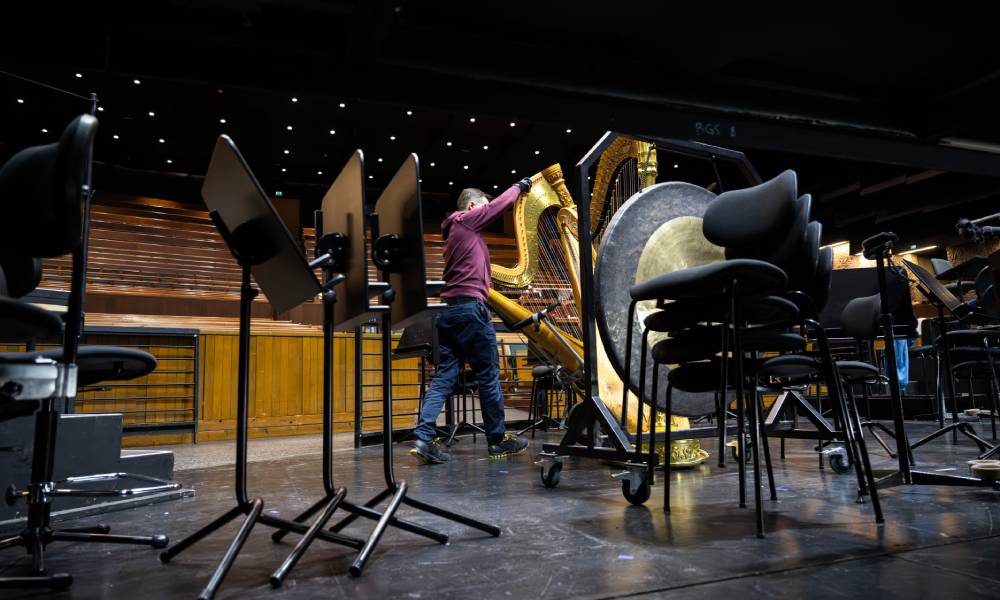
Rehearsal for Das Rheingold at the Salzburg Easter Festival 2026
Photo: Monika Rittershaus / Berliner Philharmoniker
Subscribe to our newsletter
Support Moto Perpetuo
We are an independent platform dedicated to classical music journalism. Your support helps us maintain rigorous, ad-free coverage, news, and analysis without paywalls.
donate